AI vs Traditional Model Shoots in 2026: The True Cost Comparison
Published byEmma Campbell/September 24, 2026
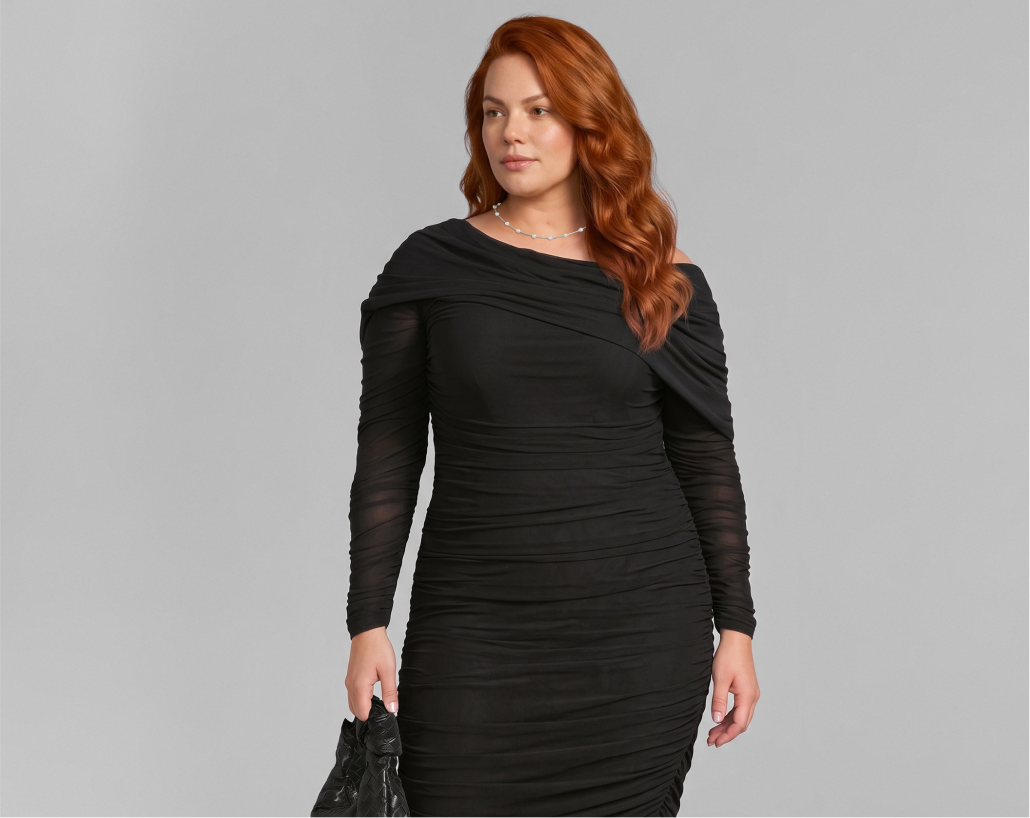



A traditional on-model shoot costs thousands per day before a single image is retouched, and that cost grows with every SKU you add. AI on-model imagery, generated from ghost mannequin or flat lay photos, removes the model, studio and crew from the equation. At Looklet, that cuts production costs by 40–50% and gets images live 88% faster than studio photography. The bigger difference shows up at catalog scale, where traditional costs keep climbing and AI costs stay close to flat.
The invoice for a shoot day is made up of several line items. Published industry benchmarks for the US put a professional photographer at $100–300 per hour, or around $1,500 for a full day, with fashion models at roughly $150–300 per hour. On top of that, studio hire runs $500–1,000 per day, hair and makeup adds $300–600, and retouching is often billed separately at $10–30 per image.
Taken together, a single shoot day lands somewhere between $3,500 and $5,500 before retouching, styling or samples are accounted for. A typical on-model studio day produces around 60 images. That puts the cost at roughly $60–90 per image before post-production. This is an illustrative figure, and your own rates will vary by market, but the structure holds everywhere: you pay per day, and you get a fixed number of images per day.

The day rate is the visible part. The larger costs tend to sit elsewhere in the business.
Time-to-market. Planning, booking, shooting and retouching take weeks. Every day a product sits in the warehouse without imagery is a day it can’t sell, and in fashion, full-price selling windows are short.
Reshoots. A garment that goes out of stock, a styling change or a new market all mean going back to the studio. The image you paid for has a limited lifespan.
Coordination overhead. Samples have to be shipped, tracked and returned. Castings, schedules and approvals take up internal time that never appears as a line item.
The long-tail gap. When budgets are fixed, hero products get shot and the rest of the assortment waits or goes without on-model imagery. That trade-off costs conversion across a large part of the catalog.
With ghost to model AI, the input is a product image you already have: a ghost mannequin, flat lay, hanger or vendor shot. There is no photographer, no hair and makeup, and no model booking. The cost shifts from per-day production to per-image processing, and the main variable is the quality control around it.
That quality control is where platforms differ. Generic AI tools are cheap per image, but when output isn’t checked, errors such as shifted necklines, lost fabric texture or color drift reach the product page. They then come back as returns. Looklet’s workflow generates multiple options, compares them against the source garment, and includes a quality review before export. It costs more than a one-click tool, and it avoids paying for errors later.
| Cost factor | Traditional model shoot | AI on-model imagery (Looklet) |
| Photographer, model, hair & makeup | Paid per day | Not required |
| Studio hire | Paid per day | Not required |
| Daily output | ~60 on-model images | Up to 500 images |
| Time to live images | Weeks | End of day or next day |
| Restyling or out-of-stock swaps | New shoot | Restyle digitally, no reshoot |
| Cost as catalog grows | Rises with every SKU | Close to flat |
Traditional photography scales in a straight line. Double the SKUs and you roughly double the shoot days. AI production doesn’t work that way, because the limiting factors of studio time and people on set are no longer part of the process.
This is why the business case gets stronger as assortments grow. Holt Renfrew has created more than 90,000 images with Looklet and cut turnaround time by 54%. Stockmann has produced more than 50,000 images with a 60% reduction in turnaround. As Heidi Kontuniemi, Manager of Digital Sale Preparations at Stockmann, puts it: “Looklet has revolutionized our cost structure, allowing us to significantly reduce expenses per item.”
For more on how speed turns into revenue, see From One Week to One Day: How AI Is Compressing Fashion E-Commerce Time-to-Market.
AI doesn’t replace every shoot. Campaign imagery, editorial storytelling and location work still benefit from a photographer and a set, where the creative concept matters more than the volume. For most brands, the smart split is to keep traditional shoots for a small number of hero moments and move the high-volume product detail page (PDP) imagery to AI. That is where the per-image economics make the biggest difference.
A lower price per image only holds if the images are right. Before comparing providers, check four things:
For a fuller evaluation framework, read How to Evaluate AI Fashion Imagery Tools: A Framework for Enterprise Retailers. For a side-by-side view of workflows, see On-Model Approaches Side by Side.
Is AI on-model imagery cheaper than a traditional photoshoot?
Yes, at almost any volume. Looklet clients typically see 40–50% lower production costs than traditional on-model photography, and the gap grows as the catalog grows.
What is image to on-model AI?
Image to on-model AI turns ghost mannequin photos into photorealistic on-model imagery without a shoot. Flat lay, hanger and vendor images can also be used as input.
How fast is AI compared with a model shoot?
A traditional shoot takes weeks from planning to publishing. With Looklet, images are delivered by the end of the day or the next day, which is 88% faster than studio photography.
Does AI replace campaign photography?
Not entirely. Most brands keep traditional shoots for campaigns and editorial work, and use AI for high-volume PDP imagery.
Sources

The PDP Feature Driving 65% Higher Conversions in Fashion E-Commerce
Read the full blog post
Bringing Images to Life: AI-Powered Video and Movement In Fashion Imagery
Read the full blog post
Why AI-Generated Models Are Redefining Traditional E-Commerce Photography
Read the full blog post